

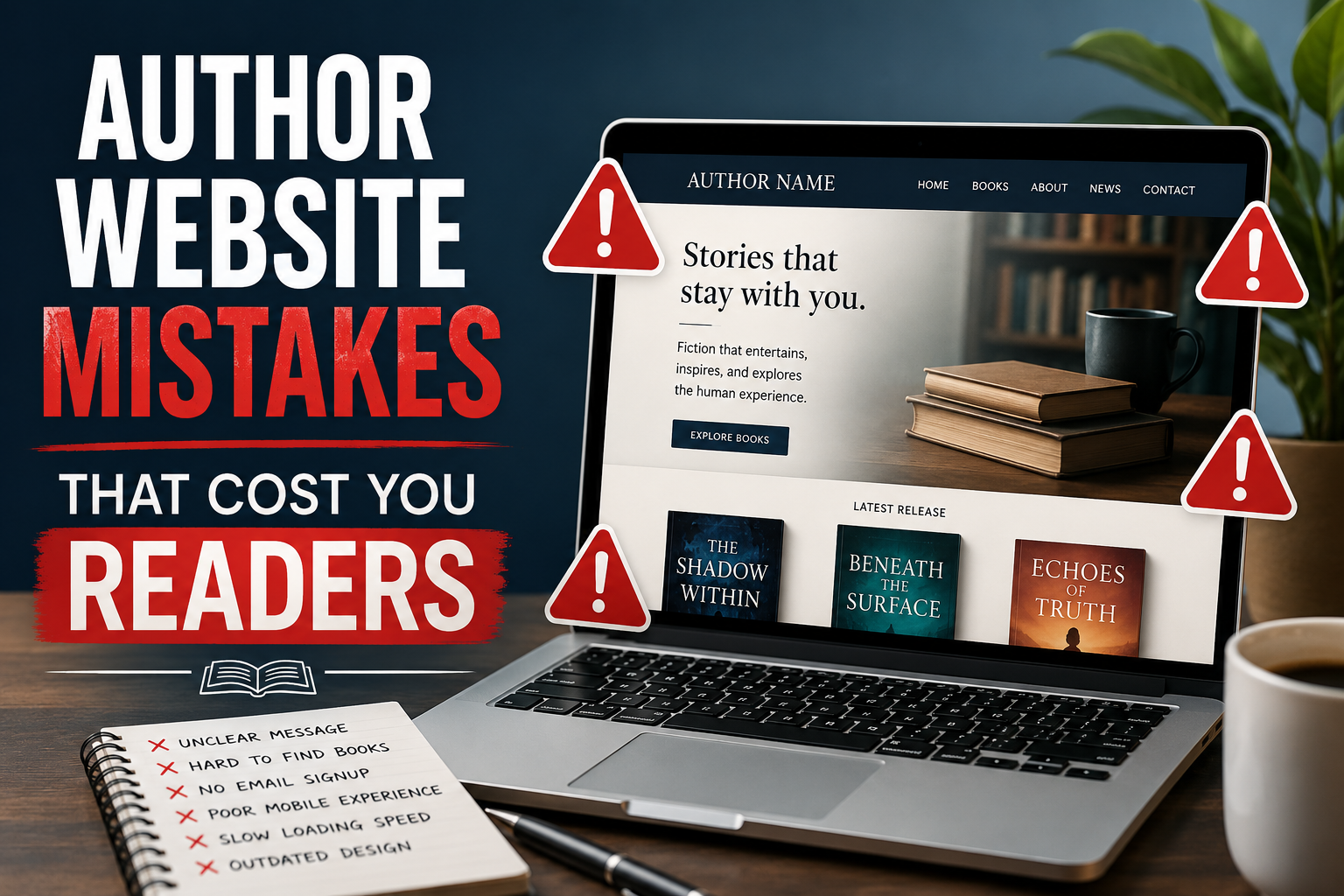
You convinced someone to visit your author website.
That is harder than it sounds.
Maybe they discovered one of your books on Amazon. Maybe they saw a social media post, heard your name on a podcast, read a review, or received a recommendation from another reader. Something made them interested enough to search for you and visit your website.
Then the site lost them.
For authors, that is a particularly expensive mistake. A website visitor is not simply traffic. That visitor may be a potential reader, newsletter subscriber, direct customer, reviewer, or fan who eventually buys every book you publish.
Your author website has a simple job: turn interest in you or your books into a continuing relationship with the reader.
Here are some of the most common mistakes that prevent it from doing that.
1. Your Website Doesn’t Immediately Tell Readers What You Write
A visitor should understand within seconds who you are and what kind of books you write.
Yet many author homepages begin with a large author photograph, the author’s name, and a generic statement such as:
Welcome to my website.
That tells a new visitor almost nothing.
Your homepage should quickly establish your author brand and genre.
A thriller writer might lead with:
Espionage thrillers where technology, intelligence, and betrayal collide.
A historical mystery author might emphasize the period and setting. A romance author might immediately identify the particular kind of romance readers can expect.
Readers frequently choose books because they want more of something they already enjoy. Make it easy for them to determine whether you provide it.
2. You Make Readers Hunt for Your Books
Your books should be among the easiest things to find on your website.
This seems obvious, but author websites frequently bury books beneath biographies, news, blog posts, awards, testimonials, and other material.
Your homepage should quickly introduce your books and provide a clear route to a dedicated Books page.
If you write a series, make the reading order obvious.
Readers should not have to determine whether Book Three comes before Book Two, whether a novella belongs between two novels, or where they should begin.
For every book, provide the essential information a prospective reader needs: cover, title, short description, series position when applicable, and clear purchase options.
The objective is not to reproduce an online bookstore. It is to remove obstacles between interest and purchase.
3. Your Site Sends Every Potential Customer Somewhere Else
Amazon, Barnes & Noble, Apple Books, Kobo and other retailers are important sales channels.
But an author website that does nothing except redirect readers to retailers gives away one of its greatest advantages.
Your website is the one digital property you control.
Social media platforms can change their algorithms. Retailers can change their rules. Search engines can change how results are displayed. Your own website provides an opportunity to develop a direct relationship with readers.
For authors who are equipped to fulfill orders, direct book sales can make the website even more valuable.
Direct sales can provide better customer information, greater control over promotions and bundles, and potentially better economics than sending every transaction through a third-party retailer.
Retailer links should remain available. The mistake is making them the only way readers can buy.
4. You Don’t Capture Email Addresses
This may be the most expensive mistake on the list.
A reader visits your site today. They like what they see but are not ready to buy.
Then they leave.
How will you reach them when your next book launches?
If the answer is “hopefully they find me again,” you have lost an important opportunity.
An email list gives authors a direct communication channel with readers who have voluntarily asked to hear from them.
Your signup invitation should also offer a reason to subscribe.
Depending on your books and audience, that might be an exclusive short story, sample chapters, bonus material, advance publication news, research notes, character profiles, or early access to a new release.
Then use the list.
A subscriber who hears from an author only when the author wants to sell a book is unlikely to remain an enthusiastic subscriber.
Email works best as an ongoing reader relationship rather than a launch-day emergency button.
5. Your Website Is About You Instead of Your Reader
Authors understandably want to tell their stories.
Where they grew up. Why they began writing. What inspired a novel. Awards they have received. Their professional history.
There is a place for all of it.
Usually, it is called the About page.
The homepage should primarily answer the visitor’s questions:
What does this author write?
Which book should I read first?
Why might I enjoy it?
Where can I get it?
How can I stay connected?
Your author biography supports your brand. It should not overwhelm the primary purpose of the website.
6. Your Website Looks Bad on a Phone
Authors sometimes evaluate their websites on the same large desktop monitor they used to build them.
Their readers may never see that version.
A significant share of visitors will arrive on phones. They may click a link from an email, social post, text message, search result, or QR code.
That makes mobile-first design especially important for author websites.
On a phone, buttons need to be easy to tap. Text needs to be readable without zooming. Book covers need enough space to be recognizable. Navigation needs to be simple. Forms should not become a chore.
And the most important information should appear before readers have scrolled through several screens.
A beautiful desktop website that is frustrating on a phone is not a beautiful website.
7. Your Pages Load Too Slowly
Readers do not admire a spectacular website they never wait long enough to see.
Huge images, unnecessary animation, poorly optimized plugins, video backgrounds, bloated themes, and inadequate hosting can all slow an author site.
The problem is particularly serious for mobile visitors.
Speed is not simply a technical issue. It is part of the reader experience.
Compress images. Use modern image formats where appropriate. Limit unnecessary scripts and plugins. Use reliable hosting. Test the site on an actual phone rather than assuming that desktop performance represents what readers experience.
Every unnecessary delay creates another opportunity for someone to leave.
8. Your Calls to Action Are Weak or Missing
What should a reader do next?
A surprising number of author websites never clearly answer that question.
Every important page should provide a logical next step.
That could be:
Buy the Book
Start the Series
Read a Sample
Join the Reader List
Get the Free Story
Explore the Books
A call to action does not need to be aggressive. It needs to be clear.
Readers should never reach the bottom of a page and wonder where to go next.
9. Your Website Is Out of Date
Nothing makes an author website look abandoned faster than a homepage announcing a “new release” from four years ago.
Old copyright dates, broken links, obsolete biographies, expired events, missing recent books, and outdated retailer links quietly undermine credibility.
The irony is that author websites do not usually require constant updating.
They require consistent maintenance.
Your core pages can remain stable for long periods. But new releases need to appear promptly, links need checking, software requires updates, backups need to work, and security needs attention.
Authors should be writing books, not spending Saturday night troubleshooting WordPress. That is one reason professionally managed author websites can make sense.
10. You Built a Website but Not an Author Platform
This is the larger mistake behind many of the others.
A website is not simply an online brochure.
Properly designed, it can become the center of an author’s reader platform.
Search introduces readers to you. Your books create interest. Your website establishes your brand. Email maintains the relationship. Direct sales can convert some of those relationships into customers. New releases bring those readers back.
Those functions should work together.
A website that merely says who you are is performing only a fraction of the job it could be doing.
11. You Depend Too Heavily on Social Media
Social media can be useful for discovery, but followers are not the same thing as an audience you control.
Platforms change.
Organic reach rises and falls. Accounts can be restricted. Features disappear. Advertising becomes more expensive. A platform popular with readers today may be far less important several years from now.
That does not mean authors should abandon social media.
It means social media should lead somewhere.
Ideally, it leads readers back to your website, where they can discover your books and join your email list.
Think of social media as an acquisition channel rather than the permanent home of your author business.
12. You Treat Your Website as a One-Time Project
Launching an author website is not the finish line.
Books change. Series grow. Covers are redesigned. New editions appear. Mailing lists expand. Reader interests change. New sales opportunities develop.
Your website should be capable of growing with your writing career without requiring a complete rebuild every time you publish another book.
That is particularly important for authors planning a series or building a substantial backlist.
The best author website is not necessarily the most complicated one.
It is the one that remains useful.
Your Website Should Turn Visitors Into Readers
Most authors do not need an elaborate website.
They need an effective one.
It should load quickly, work beautifully on a phone, immediately communicate what they write, showcase their books, make purchasing simple, capture interested readers through email, and give visitors an obvious reason to stay connected.
Above all, it should belong to the author.
Retailers help you sell books. Social networks help people discover you. Search engines help people find information.
Your website is where you bring those pieces together and build something you control.
Every visitor who arrives already has some degree of interest.
Don’t make them work to become a reader.
 Create a professional Flash Author Site built specifically for authors.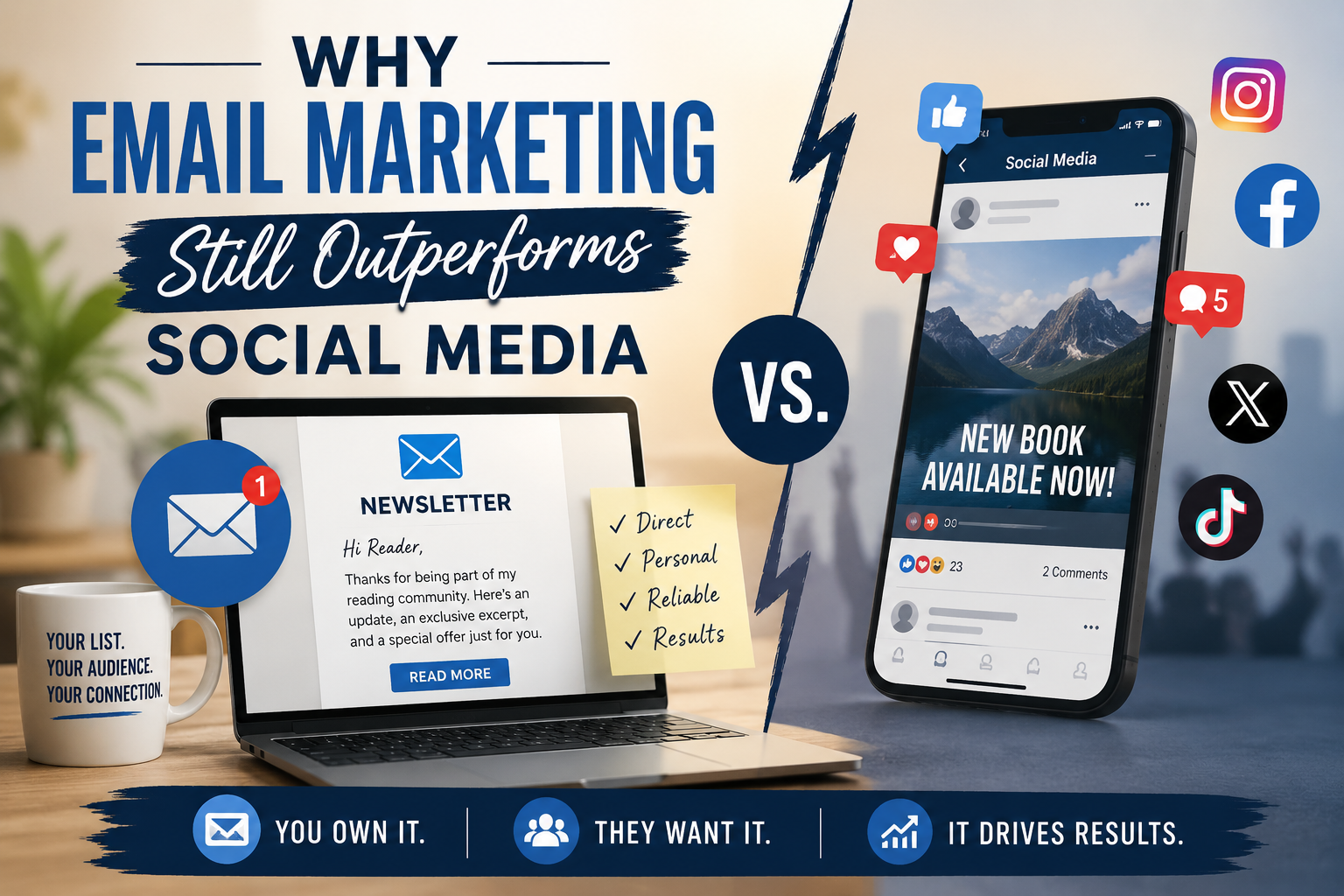

 Your books. Your brand. Your readers. One professionally managed author website.