

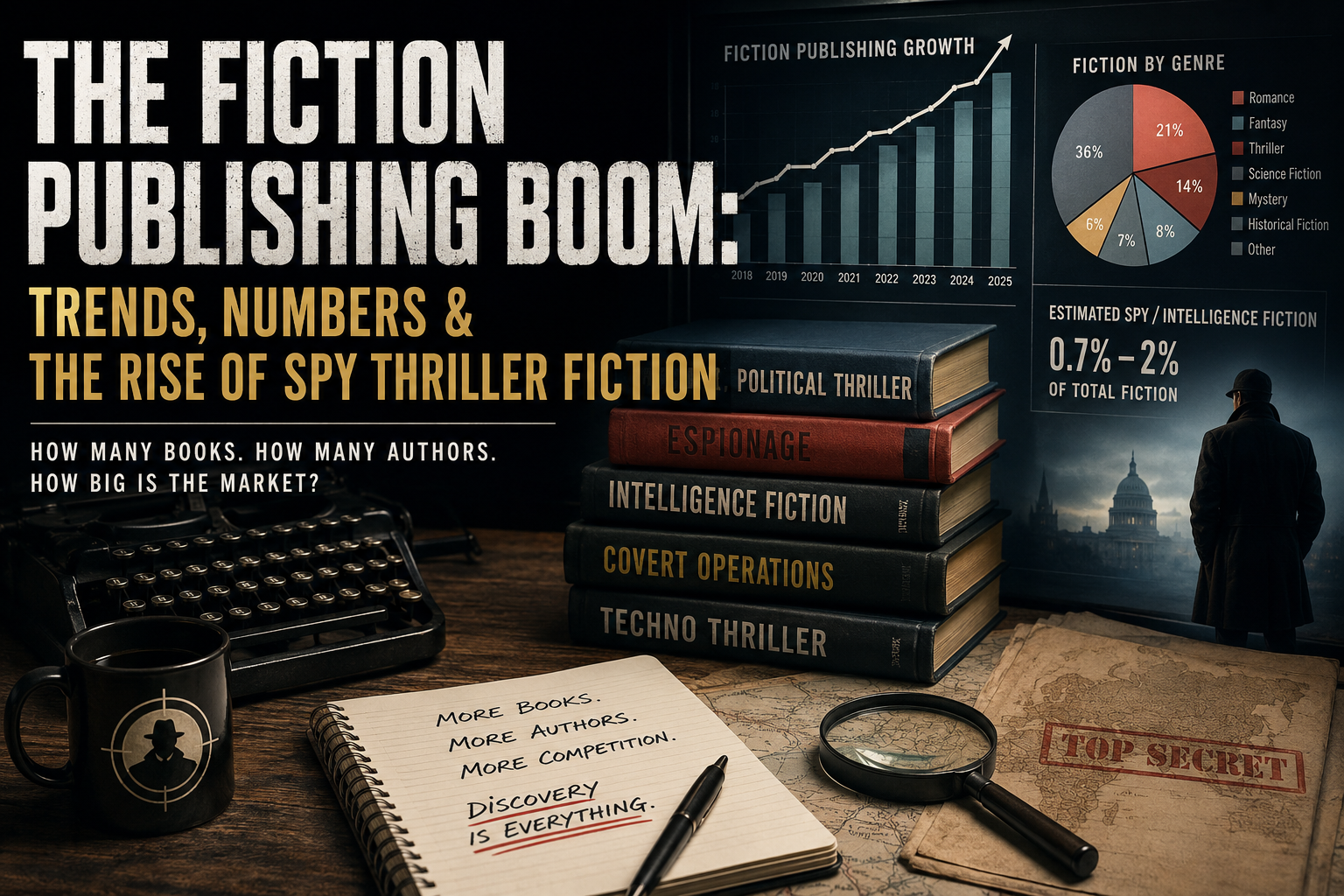
The Fiction Publishing Boom: How Many Books and Authors Are Competing for Readers?
Publishing has never been easier.
That is good news for writers and complicated news for authors trying to find readers.
The barriers that once separated an unpublished manuscript from a commercially available book have largely disappeared. An author can write a novel, commission editing and cover design, upload the finished files, and make the book available around the world without securing an agent or traditional publishing contract.
The result has been an extraordinary expansion in publishing volume, driven overwhelmingly by independent publishing.
According to Bowker figures reported by Publishers Weekly, more than four million books carrying ISBNs were published in the United States in 2025, a 32.5% increase over 2024. More than 3.5 million were self-published, while traditional publishers released 642,242 titles.
Those numbers include fiction and nonfiction and can include different formats of the same underlying work, so they should not be interpreted as four million completely distinct books.
Nevertheless, the trend is unmistakable.
There are more books competing for attention than ever before.
For fiction authors, and particularly thriller and espionage authors, understanding the size and structure of that market has become an important part of understanding the business of publishing.
Self-Publishing Has Changed the Scale of Publishing
Consider what happened in only a few years.
Bowker reported more than 2.6 million self-published titles with ISBNs in 2023, up 7.2% from 2022. Traditional publishing moved in the opposite direction that year, declining 3.6% to 563,019 titles.
In 2025, self-published output surged again to more than 3.5 million ISBN-bearing print and electronic books. Traditional output increased to 642,242.
Using those figures, approximately 85% of ISBN-bearing U.S. publishing output in 2025 was self-published, compared with roughly 15% traditionally published.
That does not mean independent books account for 85% of book sales.
Output and sales are entirely different measurements.
Traditional publishers still command enormous sales volume through established authors, bookstores, libraries, distribution networks and marketing. But when measured by the number of titles entering the marketplace, independent publishing has become the dominant force.
And even Bowker's numbers understate the full indie market because some independently published ebooks do not carry ISBNs.
How Much of This Is Fiction?
This becomes considerably harder to measure.
Industry statistics generally do a better job of measuring ISBNs and retail sales than counting unique new novels. Different editions can receive different ISBNs. Categories overlap. Children's fiction may be separated from adult fiction. Some independently published ebooks have no ISBN at all.
One widely cited industry estimate places fiction at approximately 11% of annual book output, or roughly 440,000 titles when total annual publishing is around four million books.
That figure should be treated as an estimate rather than a precise census.
Bowker's earlier category data nevertheless confirms something important: fiction has been the largest category within self-publishing. In Bowker's 2021 data, 335,428 self-published ISBNs with BISAC classifications were categorized as fiction, ahead of every other category.
Taking the available data together, a reasonable working range for the current U.S. market is approximately:
400,000 to 500,000 new fiction titles or fiction ISBN releases annually.
The true number of unique works is likely lower because multiple formats can generate multiple ISBNs, while the number of indie works omitted because they lack ISBNs pushes in the opposite direction.
There simply isn't a perfect public count.
What Genres Are Authors Writing?
The next question is even more interesting.
How is fiction divided among genres?
No central authority records every novel according to one mutually exclusive genre. A book can simultaneously be categorized as thriller, political thriller, espionage, military fiction and historical fiction.
The independent market nevertheless gives us useful clues.
Written Word Media surveyed 1,346 authors for its 2025 Indie Author Survey. Among respondents, the leading primary genres included:
| Primary genre | Share of surveyed authors |
|---|---|
| Romance | 21% |
| Fantasy | 14% |
| Thriller | 8% |
| Science Fiction | 8% |
| Mystery | 7% |
| Historical Fiction | 6% |
| Literary Fiction | ~4% |
| Other genres | Remainder |
The survey population is not a representative sample of every author in America. Written Word Media specifically notes that its audience skews toward serious commercial indie authors. But it provides one of the better contemporary snapshots of the independent fiction community.
The pattern is also remarkably consistent. Its 2024 survey found romance at 22.7%, fantasy at 12.8%, science fiction at 7.5% and thriller at 7.3%.
Thrillers therefore appear to represent roughly 7% to 8% of commercially active indie authors in this particular publishing population.
And that is before mystery is included.
Thriller Is a Major Commercial Genre
Thriller fiction occupies an interesting position in the publishing market.
Unlike some genres that lean particularly heavily toward either traditional or independent publishing, thrillers have substantial representation in both.
Major publishers continue to invest heavily in bestselling thriller writers and promising debuts because successful thrillers can generate significant hardcover, paperback, ebook and audiobook sales.
At the same time, digital publishing has created a substantial independent thriller market.
Series fiction is particularly well suited to independent publishing. A reader who discovers Book One and continues through Books Two, Three, Four and Five can be far more valuable to an author than a single-book customer.
That makes thrillers attractive to entrepreneurial authors who are willing to build catalogs rather than depend on one title.
The broader fiction market also remains healthy. U.S. print book sales totaled 762.4 million units in 2025, and adult fiction increased another 1% after growing nearly 5% in 2024.
The challenge is not whether readers still buy fiction.
They do.
The challenge is discoverability in a market containing an extraordinary number of choices.
How Large Is Spy and Intelligence Fiction?
Now we arrive at a market that is much harder to measure.
There is no reliable annual industry statistic for the number of novels classified specifically as spy fiction, espionage fiction or intelligence thrillers.
Part of the problem is taxonomy.
A novel involving CIA officers attempting to stop a terrorist operation might be categorized as:
Thriller.
Espionage.
Political thriller.
Military thriller.
International thriller.
Action and adventure.
Technothriller.
Or several of them simultaneously.
That makes any claim that precisely “X percent of fiction is spy fiction” misleading.
We can, however, establish a reasonable planning estimate.
If thrillers account for approximately 7% to 10% of commercial fiction authors or titles, and intelligence and espionage fiction represents perhaps 10% to 20% of the broader thriller category, then spy and intelligence fiction would represent approximately:
0.7% to 2% of commercial fiction
Using a midpoint of roughly 1.25% provides a useful working estimate.
If approximately 400,000 to 500,000 fiction titles or fiction ISBN releases enter the U.S. market annually, that would suggest roughly:
3,000 to 10,000 annual titles with a meaningful espionage or intelligence component
A more conservative core definition limited to recognizable spy and intelligence fiction might put the market closer to:
4,000 to 6,000 titles annually
These are estimates, not reported industry counts.
For market-planning purposes, however, they reveal something important.
Spy fiction is a niche, but it is not a tiny niche.
Traditional Versus Independent Spy Fiction
There is no authoritative source that divides annual espionage releases neatly between traditional and independent publishing.
The broader publishing trend nevertheless provides a basis for estimating the structure of the market.
Traditional publishing remains unusually visible in spy fiction because major authors, established franchises and international thrillers receive significant publisher support.
But title output is increasingly coming from independent and small-press authors.
A reasonable working estimate for current annual spy/intelligence title output would therefore be:
| Publishing path | Estimated share of titles |
|---|---|
| Independent & author-published | 60–75% |
| Traditional & established presses | 25–40% |
This estimate should not be confused with sales share.
Traditional publishers almost certainly command a much larger percentage of espionage-fiction sales than their percentage of titles because established authors can sell hundreds of thousands or millions of copies.
Indie publishing dominates the long tail.
Traditional publishing dominates much of the top end.
How Many Fiction Authors Are There?
Counting authors is considerably more difficult than counting books.
An ISBN identifies a publication, not a unique human being.
One author may release six novels in a year.
Another may publish one novel every four years.
An established author may have dozens of ISBNs attached to a catalog.
Some writers use multiple pen names.
Some books have multiple authors.
Others publish both traditionally and independently.
There is therefore no defensible official figure for the total number of active fiction authors.
But we can construct a useful market estimate.
If the United States is producing roughly 400,000 to 500,000 fiction releases annually, and active commercial fiction authors average approximately 1.5 to 2 new releases per year, annual production could represent somewhere around:
200,000 to 330,000 actively publishing fiction author identities
That should be viewed as an order-of-magnitude estimate, not a census.
Applying contemporary indie genre proportions to that range gives us another useful approximation.
| Genre | Approximate active author identities |
|---|---|
| Romance | 45,000–70,000 |
| Fantasy | 30,000–45,000 |
| Thriller | 16,000–26,000 |
| Science Fiction | 16,000–26,000 |
| Mystery | 14,000–23,000 |
| Historical Fiction | 12,000–20,000 |
| Other fiction | 65,000+ |
These categories overlap in the real world, so the table should not be added together as though each writer belongs to exactly one genre.
It is best understood as a model of the addressable author population.
How Many Spy-Thriller Authors?
Applying the same reasoning suggests a U.S. active population of perhaps:
3,000 to 7,000 authors regularly publishing recognizable espionage, intelligence or closely related spy thrillers
Expand the definition to include military, geopolitical, terrorism, covert-operations and technothrillers with significant intelligence elements, and the commercially relevant author population could reasonably approach:
8,000 to 12,000 authors
Again, these are modeled estimates.
But for a specialized business serving espionage authors, that distinction is extremely important.
The target market isn't every person who has ever written a novel.
It is a definable professional niche numbering in the thousands.
How Many New Fiction Authors Enter the Market Every Year?
This may be the hardest number of all.
Publishing statistics count books, not first-time authors.
Traditional publishers announce debut authors, but there is no comparable comprehensive database covering the enormous independent market.
We therefore have to estimate.
Suppose the current U.S. fiction market produces approximately 400,000 to 500,000 releases annually. If roughly 15% to 25% of the authors responsible for those releases are publishing fiction commercially for the first time, that would suggest approximately:
40,000 to 70,000 new fiction authors entering the U.S. publishing marketplace each year.
A substantial majority are likely to enter through self-publishing or very small presses rather than major traditional publishers.
Applying genre proportions gives a rough estimate of:
8,000–15,000 new romance authors
5,000–10,000 new fantasy authors
3,000–5,000 new thriller authors
3,000–5,000 new science-fiction authors
3,000–5,000 new mystery authors
And perhaps:
500–1,500 new authors annually entering the broader spy, espionage, intelligence, military and geopolitical thriller market.
These figures are estimates based on publishing volumes and genre distributions, not official industry statistics.
But they illustrate the continuing replenishment of the author market.
The Indie Author Is Now the Center of Publishing Growth
Perhaps the most significant publishing trend isn't simply the number of books.
It is who is publishing them.
In Written Word Media's 2025 survey, 77% of respondents identified as self-published, another 17% as hybrid authors and only 5% as exclusively traditionally published. The organization cautions that its audience naturally skews indie, but the numbers demonstrate how mature independent publishing has become.
Bowker's title statistics make the structural shift even clearer.
More than 3.5 million self-published ISBN-bearing books appeared in 2025 compared with 642,242 traditionally published books.
Independent publishing is no longer a marginal alternative to the publishing industry.
It is one of the principal engines driving publishing volume.
For businesses serving authors, that changes the customer as well.
The author increasingly makes decisions that once belonged to a publishing house.
The author selects the editor.
The author commissions the cover.
The author chooses distribution.
The author controls pricing.
The author builds the website.
The author develops the mailing list.
The author buys advertising.
The author manages the brand.
And increasingly, the author sells directly to readers.
More Books Means Discoverability Matters More
The technology required to publish a professional-looking book has become increasingly accessible.
The scarce resource is no longer access to a printing press.
It is attention.
An author isn't competing only with the handful of books displayed on the new-release table at a bookstore.
A new thriller enters a marketplace containing millions of existing books and thousands of new titles competing for many of the same readers.
That changes the fundamental publishing question.
It used to be:
How do I get published?
Increasingly, the harder question is:
How does anyone discover that I have been published?
That is why author branding, professional covers, metadata, websites, email lists, reader communities, direct sales, reviews, search visibility and genre-specific discovery have become so important.
Publishing has been democratized.
Discovery has not.
A Particularly Interesting Opportunity in Spy Fiction
For espionage authors, there is another side to this story.
A specialized genre can be easier to define and serve than fiction as a whole.
Spy-fiction readers frequently move across traditional publishing and indie publishing without caring who owns the imprint. They follow subjects, authors, characters, series and particular types of stories.
CIA fiction.
MI6 thrillers.
Cold War espionage.
Military intelligence.
Counterintelligence.
Cyber espionage.
Political thrillers.
Covert operations.
Technothrillers.
Historical espionage.
Those interests create communities that general book-discovery systems often handle poorly.
The continuing expansion of independent publishing only increases the need for better genre-specific discovery.
There may be thousands of intelligence and espionage novels entering the market every year.
The problem isn't that readers have too few books to choose from.
The problem is connecting the right reader with the right book.
The Publishing Boom Is Really a Discovery Boom Waiting to Happen
More than four million ISBN-bearing books were published in the United States in 2025.
More than 3.5 million were self-published.
Fiction remains one of the most important categories in independent publishing, and commercial genres such as romance, fantasy, science fiction, mystery and thriller account for a substantial portion of the serious indie-author community.
Within that enormous market, espionage and intelligence fiction represents a comparatively narrow but substantial specialty.
Our working estimates suggest several thousand active U.S. authors, potentially 4,000 to 6,000 core spy/intelligence titles entering the market annually, and perhaps 500 to 1,500 new writers entering the broader espionage/thriller category each year.
Those figures will never be as precise as an ISBN count because the publishing industry doesn't maintain a census of spy writers.
But the direction is clear.
The number of books is increasing.
The number of independent authors is increasing.
The barriers to publication continue to fall.
And the competition for reader attention continues to rise.
For today's fiction author, finishing the manuscript is an extraordinary accomplishment.
Publishing it has become comparatively easy.
Being discovered is now the hard part.
Sources and Methodology
Reported publishing totals in this article are principally based on Bowker statistics reported by Publishers Weekly, together with contemporary author survey data from Written Word Media and print-sales data from Circana BookScan as reported by Publishers Weekly. Genre-specific author counts, annual new-author counts and spy/intelligence-fiction figures are expressly identified as estimates because no authoritative industry census currently measures those populations.
 Create a professional Flash Author Site built specifically for authors.



 Your books. Your brand. Your readers. One professionally managed author website.